
Certified translation of a Land Registry extract and real estate documents
A Land Registry (Tabu) extract shows who owns a property in Israel, its size and what is registered against it: appurtenances, leases, mortgages and notes. When an Israeli property comes up in proceedings abroad, the extract and the property documents are required in English, in a translation certified by a notary.
A certified notarial translation is a translation whose accuracy a notary certifies under section 7(4) of the Notaries Law, 5736-1976, and the certificate is bound together with the document and the translation.
When is a certified translation of a Land Registry extract needed?
A certified translation of a Land Registry extract is needed in inheritance proceedings abroad when the estate includes a property in Israel, when a bank or lender abroad examines an Israeli property, in divorce or property division proceedings in another country, and when property owners living abroad need to show their rights.
- Inheritance proceedings abroad, when the estate includes an apartment or a plot in Israel.
- A bank or lender abroad examining a property in Israel or the source of funds.
- Divorce or property division in proceedings conducted outside Israel.
- Property owners living abroad who need to show their rights in the property.
How is an extract translated?
A Land Registry extract is made up of tables: block, parcel and sub-parcel, apartment description, appurtenances, ownership, leases, mortgages and notes. The translation keeps the table structure, so that the reader abroad finds each detail in the same place as in the original. Terms such as condominium, appurtenance, capitalised lease or caution note are rendered with the usual English terms rather than word for word.
Arnona bills and other property documents
Alongside the extract we also translate Arnona (municipal property tax) bills, sale or rental agreements and local authority confirmations. An Arnona bill is often also used as proof of residential address, for example when opening a bank account abroad.
How does it work?
Send a scan or a clear photograph by WhatsApp or email and receive a quote based on the word count. After translation and checking the names against the passports, the notary certifies and binds the certificate together with the copy of the document and the translation, and if the destination country is party to the Hague Convention, an apostille is added where required.
Send the document
Send a scan or a clear photograph by WhatsApp or email, and receive a quote based on the word count.
We translate and check the names
The translation must be faithful to the original document, and it is important to check the spelling of names against the passports, so that it matches the other documents.
The notary certifies and signs
The notarial certificate is signed and bound together with the copy of the document and the translation.
Apostille, if required
If the destination country is party to the Hague Convention, an apostille is added where required (please confirm this with the body requesting the document).
An example from our work
A real translation done at the office. All identifying details have been redacted.
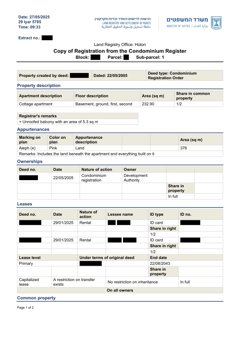
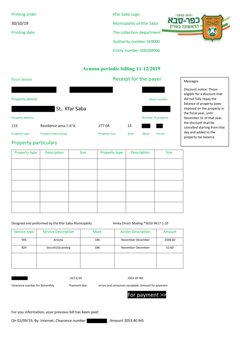
Land Registry extract: a digital apostille from gov.il, or a certified translation
A Land Registry extract signed with an approved electronic signature is an original as long as it is kept as an electronic file, as stated at the bottom of the extract. Israel's Ministry of Justice issues a digital apostille for it, ordered on gov.il. When the body abroad needs the extract in English, a certified translation is prepared and an apostille is added to the notarial certificate.
More on digital apostilles on the page Digital notarial certification and digital apostille. Information on ordering a Land Registry extract and on what it shows is on the office's site for real estate transactions, in the article on the Land Registry extract.
What does it cost?
The fee is based on the number of words in the translation and on the notarial tariff fixed by regulation, so it is the same at every notary in Israel. You can calculate the exact amount with the certified translation fee calculator.
The translation fee is based on the number of words in the translation, under the notarial tariff fixed by regulation, and it is the same at every notary in Israel. For an exact calculation by word count, see the certified translation fee calculator, and for the full tariff, the fees page.
The office translates from Hebrew into English and from English into Hebrew.
Under the 2026 tariff in the Notaries (Fees for Services) Regulations, 5739-1978, certifying a translation costs 251 ₪ before VAT for the first 100 words of the translation, 197 ₪ for each additional 100 words or part thereof up to 1,000 words, and 99 ₪ for each additional 100 words above 1,000 words. The current tariff is published by the Ministry of Justice.
Questions and answers
Can you translate an extract ordered online?
Yes. An extract ordered on the Land Authority website is translated like any other document, including the tables, the notes and the fee line.
How long does it take?
An extract of one or two pages is usually ready within one business day, sometimes on the same day. If an apostille is needed on the notarial certificate, it is obtained at a court, usually within one business day by courier.
Is an apostille needed?
It depends on the destination country. In countries that are party to the Hague Convention, usually yes. It is best to confirm this with the body requesting the document.
See also: Certified translation of a will and inheritance order | Certified translation of bank documents and statements
Certified translation of other documents: Birth certificate | Marriage and divorce certificates | Population Registry extract | Death certificate | Will and inheritance order | Academic certificates and transcripts | Driving licence | Police clearance certificate | Documents for foreign citizenship | Bank documents and statements | Judgments and agreements | Company documents | Medical documents | Professional documents
How do you contact us?
The office is at 17 Tzahal Street, Ness Ziona, in an area with easy access and parking on site. Notarial services are provided at the office, outside the office, or remotely where the law allows.
- Phone and WhatsApp052-5927592
- Emailamos@il-law.co.il
- Address17 Tzahal Street, Ness Ziona, parking nearby
- Opening hoursSun-Thu 09:00-19:00, Fri 09:00-12:30
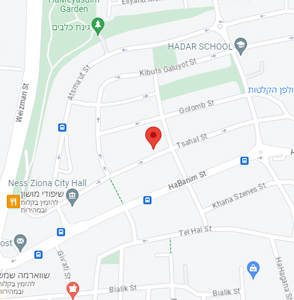
How do you get here?
17 Tzahal Street, Ness Ziona. Parking near the office, with service on the ground floor. The office is a short drive from Rehovot, Rishon LeZion and Yavne.
Get directions in Google MapsNot sure which certificate you need? Let's start with a conversation
Tell us which authority the document is intended for and for what purpose, and we will tell you exactly which notarial certificate you need, whether an apostille is required and in what order, and how much it will cost under the regulations.