
Notarial Authentication of a Signature
Signature authentication, often simply called a notary signature, is the notary's confirmation that you are the person who signed the document. That is why you must come in person, bring an ID and sign in front of the notary, as required by the Notaries Law.
Selling an apartment abroad in a 30-second video

The video loads from YouTube only after you click. Go to the video page and transcript
In the video: You own an apartment abroad and want to sell it? You do not have to fly to sign. The lawyer in the country where the apartment is located sends you the set of documents, and you sign them before an Israeli notary. The notary identifies you and certifies the signatures, and if required there, an apostille is added. Then the certified documents are sent abroad.
A notarial certificate is sufficient evidence in legal proceedings, without further proof, of what was done and said before the notary (section 19 of the Notaries Law).
When do you need a notary to authenticate a signature?
Notarial authentication of a signature is required for a document for use abroad, including at a foreign mission in Israel, a general power of attorney or one for a real estate transaction requiring registration, and affidavits, declarations and agreements on which a body in Israel or abroad requires an authenticated signature. The notary can also certify that a person signing for a company or another person was authorised.
- A document intended for use abroad, including at the mission of a foreign state in Israel. Under section 8 of the Notaries Law, a signature for that purpose may be authenticated only by a notary.
- A general power of attorney, and a power of attorney for a real estate transaction requiring registration (section 20 of the Notaries Law).
- Affidavits, declarations and agreements on which a body in Israel or abroad requires an authenticated signature.
- Signing on behalf of a company or of another person: the notary can also certify that the signatory was authorised to sign (section 14 of the Notaries Law).
The process
Send the document in advance by WhatsApp or email, book an appointment that all signatories attend in person, and sign before the notary after identification. The notarial certificate is attached to the document, and for a country party to the Hague Convention an apostille can be added.
Send the document
We recommend sending the document in advance by WhatsApp or email, so that we can check exactly what is required.
Book an appointment
All signatories attend in person.
Identification and signature
The notary identifies the signatory, who signs in his presence. Do not sign the document in advance.
The certificate, and an apostille if required
The notarial certificate is attached to the document. If the document is intended for a country party to the Hague Convention, an apostille can be added.
What should you bring?
Bring a valid identity document, an identity card or passport, and the document itself, unsigned. When signing on behalf of a company, also bring documents proving the authority to sign, and a person in hospital or confined to bed needs a medical certificate in the form set out in the regulations, issued on the day of signing.
- A valid identity document: an identity card or a passport.
- The document itself, unsigned.
- When signing on behalf of a company: documents proving the authority to sign, such as a company extract from the Registrar of Companies or a company resolution.
- A person in hospital or confined to bed: a medical certificate in the form set out in the First Schedule to the Notaries Regulations, 5737-1977, issued on the day of signing. In the certificate, the doctor confirms that the person is fully conscious, of sound mind and competent to perform an act before a notary (regulation 4(e) of the Regulations).
Timing and cost
An appointment can usually be arranged for the same day or the next, and the authenticated document is handed over as soon as it ends. The fee is fixed by regulation: NIS 197 for the first signatory and NIS 77 for each additional signatory, plus VAT, and an apostille, if required, is usually added within one further business day.
Timing: An appointment can usually be arranged for the same day or the next. The authentication takes place at a single meeting, and the authenticated document is handed over as soon as it ends. If an apostille is required, it is usually added within one further business day.
Cost: The notary fee is fixed by regulation: NIS 197 for the first signatory, NIS 77 for each additional signatory on the same document, and a further NIS 77 for certifying that a person signing on behalf of another was authorised to do so. The amounts are those of the 2026 tariff under the Notaries (Service Fees) Regulations, plus VAT. For an exact calculation for your service, see the notary fee calculator.
If you are unable to come to the office, you may ask for the service at home, in hospital or in a care home. Under the regulations, a surcharge of NIS 645 then applies for the first hour, plus travel expenses.
Notarial authentication of a signature compared with an advocate's certification
A document for use abroad, and a general power of attorney or one for a real estate transaction, are authenticated by a notary only, except a power of attorney given to an advocate who has himself certified the client's signature. For any other document for use in Israel, it depends on what the receiving body requires, and sometimes an advocate's certification is sufficient.
| Document | Who may authenticate |
|---|---|
| A document for use abroad | A notary only (section 8 of the Notaries Law). |
| A general power of attorney or one for a real estate transaction | A notary (section 20 of the Notaries Law). Exception: a power of attorney given to an advocate who has himself certified the client's signature on it (section 91 of the Israel Bar Association Law). |
| Any other document for use in Israel | This depends on what the receiving body requires. Sometimes an advocate's certification is sufficient. |
Sources
- Notaries Law, 5736-1976: section 8 (use abroad), section 10 (relatives), section 11 (signature certification: the signer stands before the notary, is identified and signs in his presence), section 14 (authority to sign for another), section 19 (evidentiary force of the certificate), section 20 (powers of attorney). Hebrew.
- Chamber of Advocates Law, 5721-1961: section 91 (a power of attorney to an advocate who certified the client's signature). Hebrew.
- Notaries Regulations, 5737-1977: regulation 4(e) (a medical certificate dated the day of the act for a person hospitalised or bedridden). Hebrew.
Checked on 23 October 2026.
Frequently asked questions
Can a signature be authenticated remotely or by video call?
No. Under section 11 of the Notaries Law, the signatory must appear before the notary, be identified and sign in his presence.
I have already signed the document. What should I do?
The notary authenticates only a signature made in his presence. Bring an unsigned copy, or sign again at the appointment.
Can a notary authenticate the signature of a relative?
No. Under section 10 of the Notaries Law, a notary may not exercise his powers in a matter concerning himself, his relative, his partner or his employee.
The document is going abroad. Do I also need an apostille?
That depends on the destination country and on the body requesting the document, so it is best to confirm it with them. If one is required, the office can also handle the apostille.
I need several copies authenticated. What does that cost?
Under the regulations, each additional copy authenticated at the same time costs NIS 77 plus VAT. For an exact calculation for your service, see the notary fee calculator.
Related pages: Notarial power of attorney | Apostille | Notary fees 2026
Contact us
The office is at 17 Tzahal Street, Ness Ziona, in an area with easy access and parking on site. Notarial services are provided at the office, outside the office, or remotely where the law allows.
- Phone and WhatsApp052-5927592
- Emailamos@il-law.co.il
- Address17 Tzahal Street, Ness Ziona, parking nearby
- Opening hoursSun-Thu 09:00-19:00, Fri 09:00-12:30
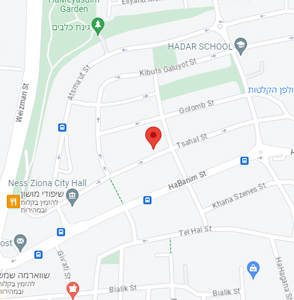
How do you get here?
17 Tzahal Street, Ness Ziona. Parking near the office, with service on the ground floor. The office is a short drive from Rehovot, Rishon LeZion and Yavne.
Get directions in Google MapsNot sure which certificate you need? Let's start with a conversation
Tell us which authority the document is intended for and for what purpose, and we will tell you exactly which notarial certificate you need, whether an apostille is required and in what order, and how much it will cost under the regulations.