
Certification of a prenuptial agreement
A prenuptial agreement is an agreement between spouses that regulates the property relations between them, and it must be made in writing (section 1 of the Spouses (Property Relations) Law, 5733-1973). To be valid, it requires approval.
An agreement made before the marriage may be certified by a notary, provided that the notary is satisfied that the couple made it freely and with an understanding of its meaning and consequences (section 2(c1) of the Spouses (Property Relations) Law, and section 7(11) of the Notaries Law, 5736-1976).
The office drafts prenuptial agreements and certifies them, or certifies a text prepared in advance.
Prenuptial Agreement: Notarial Approval Before the Wedding in a 30-second video
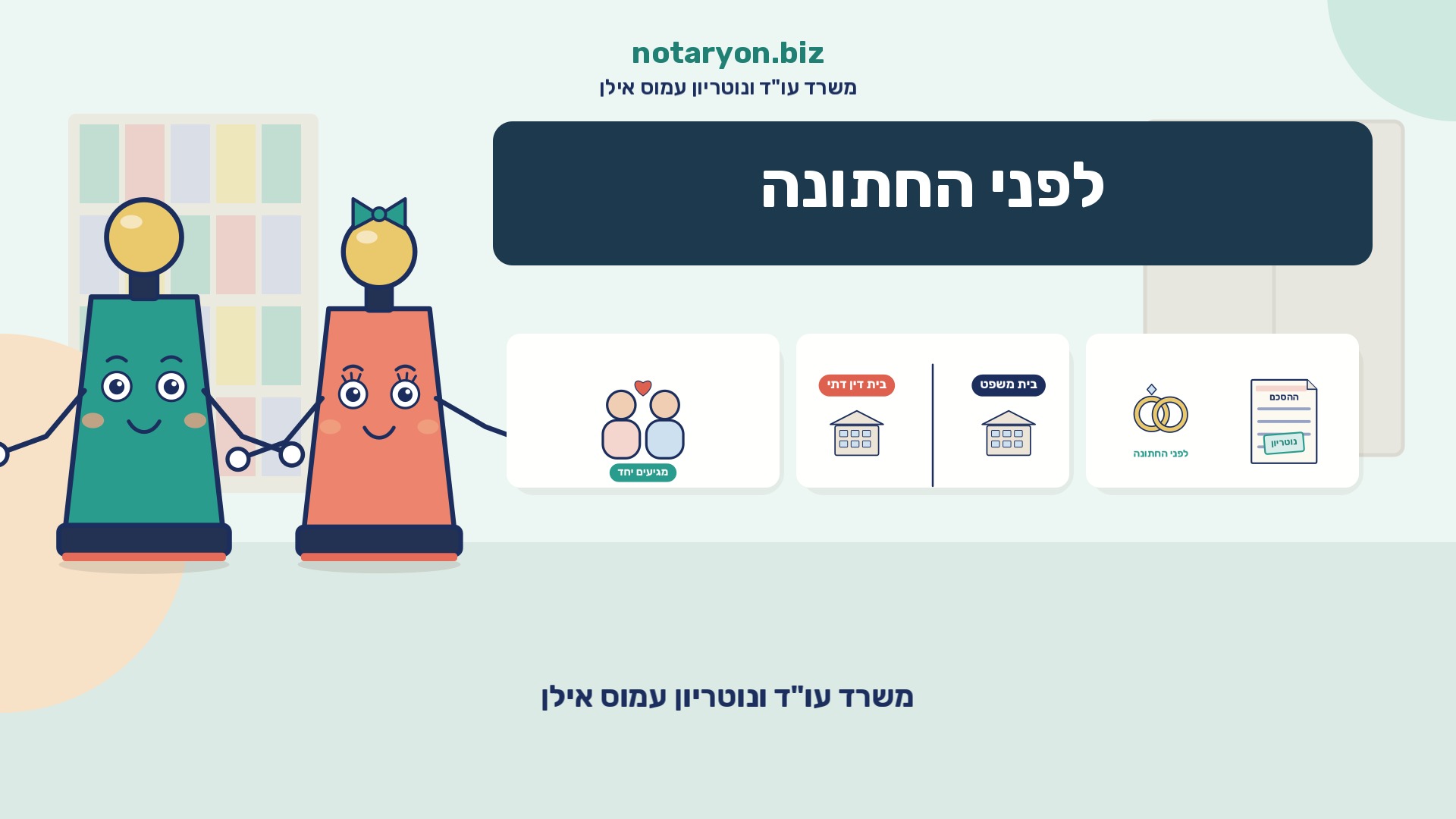
The video loads from YouTube only after you click. Go to the video page and transcript
A prenuptial agreement: before or after the wedding? Hi, I'm Chotmi! Chotmit is getting married next month. A short story: she and her partner want a prenuptial agreement. Before the wedding, a notary can certify the agreement. After the wedding? Only a court or a religious court. Both partners come together. The agreement must be in writing. And it does not replace a will. Getting married soon? notaryon.biz
When do you make a prenuptial agreement before a notary?
A prenuptial agreement before a notary is made before the wedding, where one of the spouses brings an apartment, a business, savings or an expected inheritance, in a second marriage with children from a previous relationship, or where the couple want an arrangement different from the statutory resources balancing arrangement.
- Before the wedding, where one of the spouses brings an apartment, a business, savings or an expected inheritance.
- In a second marriage, where there are children from a previous relationship and certain assets are to be preserved for them.
- Where the couple wish to set in advance an arrangement different from the statutory resources balancing arrangement.
- Couples who do not intend to marry can sign a cohabitation agreement. It is not subject to the Spouses (Property Relations) Law, and the parties' signatures on it can be authenticated before a notary.
The process
We establish the couple's status and what they wish to regulate, the advocate drafts the agreement or reviews an existing text, and both spouses attend a certification meeting together. The notary makes sure that the consent is free and understood, and the agreement is signed, certified and handed to the couple.
Initial consultation
We establish the couple's status (before marriage, married, or cohabiting) and what they wish to regulate.
Drafting or reviewing the text
The advocate drafts the agreement, or reviews a text prepared by another lawyer.
Certification meeting
Both spouses attend together. The notary must be satisfied that they are making the agreement freely and understand its meaning and consequences.
Signing and delivery
The agreement is signed, certified with the notary's seal, and handed to the couple.
What should you bring?
Bring a valid identity card or passport for each spouse, the text of the agreement if it has already been drafted, details of the assets it deals with, and for an update, the existing agreement. A person in hospital or confined to bed also needs a medical certificate.
- A valid identity card or passport for each spouse.
- The text of the agreement, if it has already been drafted.
- Details of the assets the agreement deals with.
- For an update: the existing agreement.
- A person in hospital or confined to bed: a medical certificate in the form set out in the First Schedule to the Notaries Regulations, 5737-1977, issued on the day of signing. In the certificate, the doctor confirms that the person is fully conscious, of sound mind and competent to perform an act before a notary (regulation 4(e) of the Regulations).
Timing and cost
A first meeting can usually be arranged for the same day or the next, and drafting usually takes a few days. The notary fee for certifying a prenuptial agreement is fixed by the regulations: NIS 446, and NIS 74 for each additional copy, plus VAT, and drafting is priced separately.
Timing: a first meeting can usually be arranged for the same day or the next. Drafting the agreement usually takes a few days, depending on its complexity. Once the agreement is ready, certification takes place at a single meeting, and the certified agreement is handed to the couple as soon as the meeting ends.
Cost: the notary fee for certifying a prenuptial agreement is fixed by the regulations: NIS 446, and NIS 74 for each additional copy certified at the same time. The amounts are those of the 2026 tariff under the Notaries (Service Fees) Regulations, plus VAT. For an exact figure for your service, see the notary fee calculator.
Drafting the agreement is separate legal work, and is priced separately according to its complexity.
Notarial certification compared with court approval
An agreement made before the marriage can be approved by a notary, the Family Court or a religious court. An agreement signed after the marriage, and an amendment made after the marriage, require the approval of the court or the religious court only.
| Situation | Who may approve it |
|---|---|
| An agreement made before the marriage | A notary (section 2(c1) of the Spouses (Property Relations) Law), the Family Court or a religious court. |
| An agreement signed after the marriage | The Family Court or a religious court only (section 2(a) of the Spouses (Property Relations) Law). |
| Amending an existing agreement | Requires approval in the same way as the agreement itself (section 2(a) of the Spouses (Property Relations) Law). An amendment made after the marriage requires the approval of the court or the religious court. |
What happens without a prenuptial agreement?
Without a prenuptial agreement, the balancing of resources arrangement under the Spouses (Property Relations) Law applies, and when the marriage ends each spouse is entitled to half the value of both spouses' assets, except assets from before the marriage, gifts and inheritances. In practice the lines blur, for example with an apartment renovated with joint money.
Spouses who marry without a property agreement are subject to the balancing of resources arrangement under the Spouses (Property Relations) Law. When the marriage ends, by divorce or death, each spouse is entitled to half the value of both spouses' assets. Excluded from the balancing are assets that one of them had before the marriage, and gifts or inheritances received during it.
It sounds simple, but in practice the lines blur. An apartment registered in one spouse's name before the wedding, in which the couple lived for years, renovated with joint money or paid the mortgage on together, may become the subject of a claim that it has become jointly owned. The same applies to a business that one spouse founded before the marriage and kept developing during it. A prenuptial agreement settles in advance what remains whose, and avoids that dispute.
What does a prenuptial agreement cover?
A prenuptial agreement sets what happens to separate assets and to assets acquired in the future, expected inheritances and gifts, debts and housing on separation. It does not replace a will, and it cannot deny the children's right to maintenance.
- Separate assets: an apartment, a business, savings or shares that each partner brings into the marriage, and the agreement that they remain theirs even if they are used jointly.
- Assets acquired in the future: what will be joint and what separate, for example an apartment bought during the marriage, pension savings and benefits.
- Expected inheritances and gifts: especially when parents plan to transfer property or a family business.
- Debts: who is responsible for the debts each partner brings, and for debts that arise later.
- Housing on separation: who stays in the home, and for how long.
What a prenuptial agreement cannot do: it does not replace a will. Under the Succession Law, an agreement about the estate of a living person, and a waiver of an inheritance during the lifetime of the deceased, are void. Anyone who wants to determine what the spouse will receive after their death therefore also needs a will. An agreement between the spouses also cannot take away the children's right to maintenance, and custody questions are always decided in the best interests of the child.
Second marriages, cohabiting partners and partners who speak different languages
In a second marriage, it is worth combining a prenuptial agreement with coordinated wills of both partners. Cohabiting partners can sign a cohabitation agreement, and when one partner does not read Hebrew, the agreement can be drawn up in English or in both languages.
Second marriages: where there are children from a previous relationship, a prenuptial agreement is sometimes the only way to ensure that an apartment or savings remain for them. The right combination is a prenuptial agreement alongside wills of both partners that are coordinated with each other.
Cohabiting partners: the Spouses (Property Relations) Law applies to married couples. Partners who live together without marrying can sign a cohabitation agreement that deals with the same issues. The agreement does not need a notary to be valid, but having the signatures authenticated before a notary records that the parties signed it and when, and makes it harder to deny in the future.
When one partner does not read Hebrew: the agreement can be drawn up in English, or in both languages side by side. The notary must be satisfied that both partners understand the agreement and its consequences, so it is important that each of them reads it in a language they understand.
Common mistakes
The common mistakes are signing at the last minute and under pressure, a generic text from the internet that does not describe the actual assets, a partner who did not get their own advice, and an agreement not updated after a joint purchase of an apartment, setting up a business or a significant inheritance.
- Signing at the last minute: an agreement signed a few days before the wedding, under pressure, may be challenged on the ground that it was not signed of free will. It is worth starting weeks or months in advance.
- A generic text from the internet: an agreement that does not describe the actual assets, or does not address the apartment the couple will live in, leaves open exactly the questions it was meant to settle.
- A partner without advice: when one lawyer drafts for one side, it is worth the other side getting independent advice too. This strengthens the agreement against future claims.
- An agreement that is not updated: after a joint purchase of an apartment, setting up a business or a significant inheritance, it is worth checking whether the agreement still reflects what you both want. A change after the wedding requires the approval of the court or the religious court.
Frequently asked questions
Do both spouses have to attend?
Yes. The notary must be satisfied that both of them made the agreement freely and understand its meaning, so both attend in person.
Does the notary also draft the agreement?
Yes. The agreement can be drafted at the office and certified there, or you can bring a ready text for certification only.
We are already married. Can we still make a prenuptial agreement?
Yes, but a notary cannot then certify it. An agreement signed after the marriage requires the approval of the Family Court or a religious court.
What happens if no prenuptial agreement is signed?
The resources balancing arrangement under Chapter Two of the Spouses (Property Relations) Law applies.
Can cohabiting couples make a prenuptial agreement?
The Spouses (Property Relations) Law applies to married couples. Cohabiting couples can sign a cohabitation agreement and have their signatures authenticated before a notary.
Related pages: Notarial will | Authentication of a signature | Notary fees 2026
Contact us
The office is at 17 Tzahal Street, Ness Ziona, in an area with easy access and parking on site. Notarial services are provided at the office, outside the office, or remotely where the law allows.
- Phone and WhatsApp052-5927592
- Emailamos@il-law.co.il
- Address17 Tzahal Street, Ness Ziona, parking nearby
- Opening hoursSun-Thu 09:00-19:00, Fri 09:00-12:30
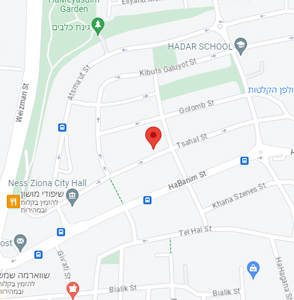
How do you get here?
17 Tzahal Street, Ness Ziona. Parking near the office, with service on the ground floor. The office is a short drive from Rehovot, Rishon LeZion and Yavne.
Get directions in Google MapsNot sure which certificate you need? Let's start with a conversation
Tell us which authority the document is intended for and for what purpose, and we will tell you exactly which notarial certificate you need, whether an apostille is required and in what order, and how much it will cost under the regulations.